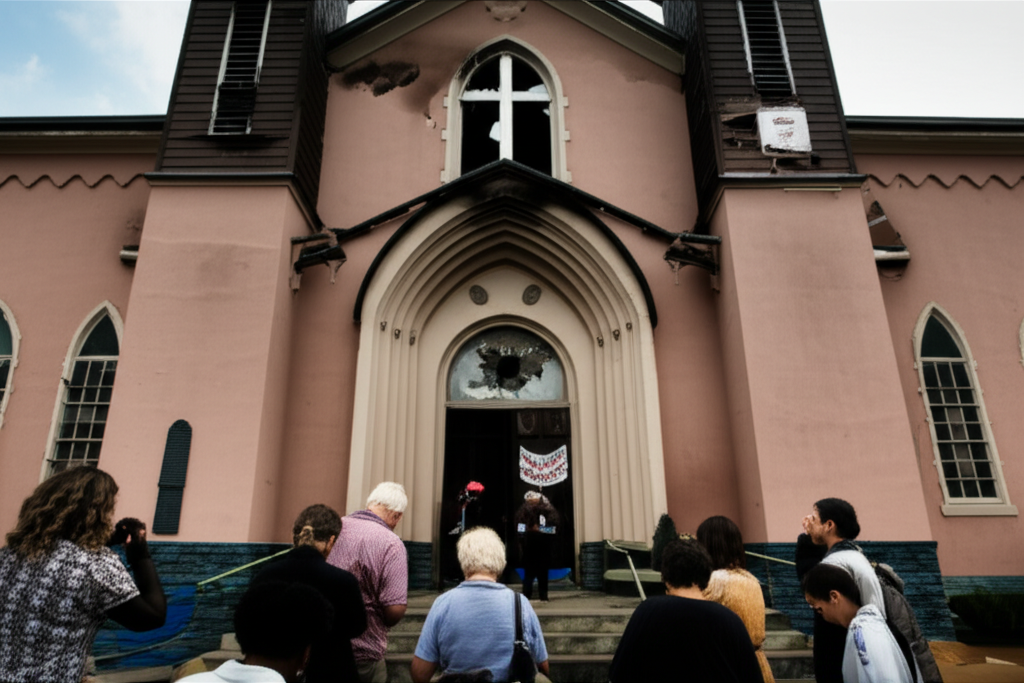
What happens when the place you go for refuge becomes a target? In January 2026, Windwood Free Will Baptist Church in Oklahoma City—a community cornerstone serving as a voting precinct, school pickup site, and tornado relief center for 30 years—was vandalized and set on fire. Graffiti scarred its walls, flames gutted its interior. Yet the next Sunday, the congregation gathered in the parking lot, worshiping amid the ashes.
This isn’t an isolated incident. It’s part of a disturbing trend that’s forcing the American church to rediscover what it means to suffer for the name of Christ. And in that rediscovery, we might just find the resilience our faith has been missing.

The Alarming Rise in Church Attacks
The numbers don’t lie—and they should shake us. According to the Family Research Council, there were 415 acts of aggression against 383 churches in 2024 alone—the highest on record. These incidents ranged from arson and vandalism to protests disrupting worship services.
Zoom out further: The FBI’s Crime Data Explorer reports 1,380 hate crimes against Jews compared to 265 combined against Catholics, Eastern Orthodox, Protestants, and other Christians from January 2025 to January 2026. While Jewish communities face significantly more hostility, the trend for Christians is upward and undeniable.
One stark example: In January 2026, protesters disrupted a service at Cities Church in St. Paul over the church’s immigration advocacy, turning a place of worship into a political battleground. As KFOR News reported on the Windwood arson, this wasn’t just property damage—it was an attack on a hub of community service.
‘Beloved, do not be surprised at the fiery trial when it comes upon you to test you, as though something strange were happening to you. But rejoice insofar as you share Christ’s sufferings, that you may also rejoice and be glad when his glory is revealed.’
A Reformed Perspective: Persecution as Refinement
As a Reformed theologian, I see these trends not as defeat, but as divine refinement. The Heidelberg Catechism reminds us that even our sufferings are part of God’s fatherly care, working all things for our good (Q&A 26). But let’s be honest—American Christianity has grown soft, optimized for comfort rather than endurance.
Tim Keller captured this tension beautifully:
‘Suffering is not a detour in the journey of faith, but the very path God uses to conform us to the image of His Son.’
Charles Spurgeon, preaching amid his own trials, added:
‘Trials teach us what we are; they dig up the soil, and let us see what we are made of.’
These aren’t platitudes. They’re anchors for a church under fire.

Lessons from Church History: When Persecution Fuels Growth
History shows that hostility often precedes revival. In the early church, Nero’s persecutions scattered believers across the empire—yet Acts 8:4 tells us those scattered went everywhere preaching the word. What the enemy meant for destruction, God used for multiplication.
During the Reformation, the blood of martyrs like John Huss and William Tyndale became the seed of the church, as Tertullian famously said. Their willingness to suffer for truth inspired generations, leading to explosive growth in Protestant movements. As historian Philip Schaff notes in History of the Christian Church, persecution purified the faith, separating nominal believers from the committed.
Today, we see the same in places like Iran and China, where underground churches thrive despite crackdowns. Open Doors reports that in regions of high persecution, church growth often outpaces population growth by 300%. Adversity doesn’t kill the church—it refines it.
The Disciple Standard Response: Resilience Through Multiplication
On The Disciple Standard Podcast, Aaron Mamuyac and Scott Vander Ploeg have long warned against consumer Christianity that crumbles under pressure. Their Multiply Method—Know Jesus, Make Jesus Known, Live a Jesus Life—equips believers not just to survive hostility, but to thrive in it.
Scott’s passion for church planting shines here: when buildings burn, the church doesn’t die because the church isn’t a building. It’s people discipled to disciple others, even in parking lots or living rooms. As Aaron often says, ‘The local church is the hope of the world—especially when the world hopes to destroy it.’

Raising the Standard: Action Steps for a Church Under Fire
Hostility isn’t coming—it’s here. But so is our opportunity to respond with gospel resilience. Here’s how:
- Pray for persecutors. Follow Jesus’ command in Matthew 5:44. Turn aggression into intercession.
- Strengthen community ties. Build relationships now that will hold when trials come. Join or start a discipleship group focused on 2 Timothy 2:2 multiplication.
- Prepare your church. Discuss safety protocols, but more importantly, teach on suffering from Scripture. Make 1 Peter required reading.
- Engage culture boldly. Don’t retreat—advance. Share the gospel in your neighborhood, workplace, and online spaces.
- Celebrate resilience stories. Like Windwood’s parking lot worship, let these testimonies fuel your faith.
The church under fire isn’t defeated—it’s being forged. As we respond with grace, endurance, and unwavering witness, we might just see the greatest revival of our time.
For more on building resilient faith and discipleship in challenging times, tune into The Disciple Standard Podcast with Aaron Mamuyac and Scott Vander Ploeg on YouTube @thedisciplestandard, Spotify, or Apple Podcasts. Visit disciplestandard.com to raise the standard.